- Pulse by Capital Stake
- Posts
- Fuel ⛽, Inflation 📈, Markets 📉
Fuel ⛽, Inflation 📈, Markets 📉
Another Week, Another Pulse!
If last week had a soundtrack, it would be the sound of fuel pumps clicking and wallets quietly panicking.
The week kicked off with a shocker that dominated every conversation: fuel prices. The government raised petrol prices by Rs137 to Rs458 per litre and diesel by Rs184 to Rs520 per litre, an increase so sharp it immediately rippled through transport, logistics, and household budgets. Just as the dust started to settle, Shehbaz Sharif stepped in with a rapid response, announcing a Rs80 per litre cut in petroleum levy that brought petrol back down to Rs378. Alongside this, a targeted relief package was rolled out for motorcyclists, transporters, farmers, and public transport operators, an attempt to cushion the most exposed segments of the economy.
But fuel wasn’t done with us yet. Jet fuel prices climbed by Rs40, LPG prices jumped by 35%, and the cost of a standard domestic cylinder rose by Rs924. This wasn’t just a price adjustment, it was a full reset of energy costs across the board. And as expected, inflation followed. March CPI came in at 7.3% year on year, up from 7% in February, not alarming yet but clearly moving in the wrong direction.
Pakistan’s economic steering wheel remains firmly shared with the International Monetary Fund. This week brought a mix of pressure and partial relief. The IMF floated a massive Rs15.6 trillion tax target, including removing exemptions on fuel and housing, though Pakistan has not agreed so far. At the same time, approval for Rs830 billion in power subsidies came through, but with a longer term cost, electricity prices may need to rise again by January 2027. Pakistan also reiterated its willingness to raise interest rates and maintain exchange rate flexibility if inflation worsens, essentially keeping tightening measures ready if needed. The IMF board is expected to meet in early May, with around 1.2 billion dollars likely to be approved under the ongoing 7 billion dollar program, keeping the flow intact.
On the liquidity front, the State Bank of Pakistan injected over Rs13.68 trillion into the banking system through conventional and Shariah compliant operations. That reflects the government’s ongoing funding needs and the constant balancing act between maintaining liquidity and avoiding pressure on interest rates. At the same time, the government acknowledged that public debt has continued to rise, with the debt to GDP ratio worsening and per capita debt increasing despite signs of macro stability. In simple terms, we have stabilized but not reduced the burden.
There were a few pockets of relative stability. Cement dispatches came in at 3.745 million tons for March, up slightly by 0.91% year on year, not a boom but at least not a decline. Meanwhile, Pakistan’s trade deficit showed a more meaningful improvement, narrowing to 22.6 billion dollars for the first nine months of FY26, down 18.5% year on year, a sign that external pressures are easing even if domestic ones are building.
On the policy side, the government is planning to allocate Rs31 billion to maintain strategic wheat reserves, clearly driven by food security concerns amid ongoing geopolitical tensions. At the same time, taxes on imported luxury and non essential goods have climbed as high as 60%, reinforcing the broader direction of conserving dollars and prioritizing essentials.
In a more consumer-facing development, Google significantly increased pricing for its Google One cloud storage and AI subscriptions in Pakistan, with premium packages going up to Rs70,000 per month, not exactly welcome news for freelancers, creators, and small businesses relying on these tools.
One genuinely forward looking step came from the State Bank of Pakistan, which introduced a regulatory framework allowing teenagers to independently open and operate bank accounts and digital wallets nationwide. It is a small shift with long term implications, pushing financial inclusion in the right direction.
Globally, tensions added another layer of uncertainty. Donald Trump reignited rhetoric against Iran, threatening severe action if the Strait of Hormuz remains closed, while Iran’s UN mission responded sharply, warning of potential war crimes and urging global intervention. For Pakistan, this is not distant news, it feeds directly into fuel prices, trade routes, and overall economic sentiment.
As we head into the next week, the real question is not whether things will move, it is how much room there is left to absorb the movement.
🎧 Tune in to this week’s Pulse:
Youtube - https://youtu.be/2D2bLiEjoSs
📅 Key Events This Week!
📌 9th April 2026
💱 Foreign Exchange Reserves
📌 10th April 2026
📊 Weekly SPI
Note: These dates are tentative and subject to change. Credits: Pulse by Capital Stake
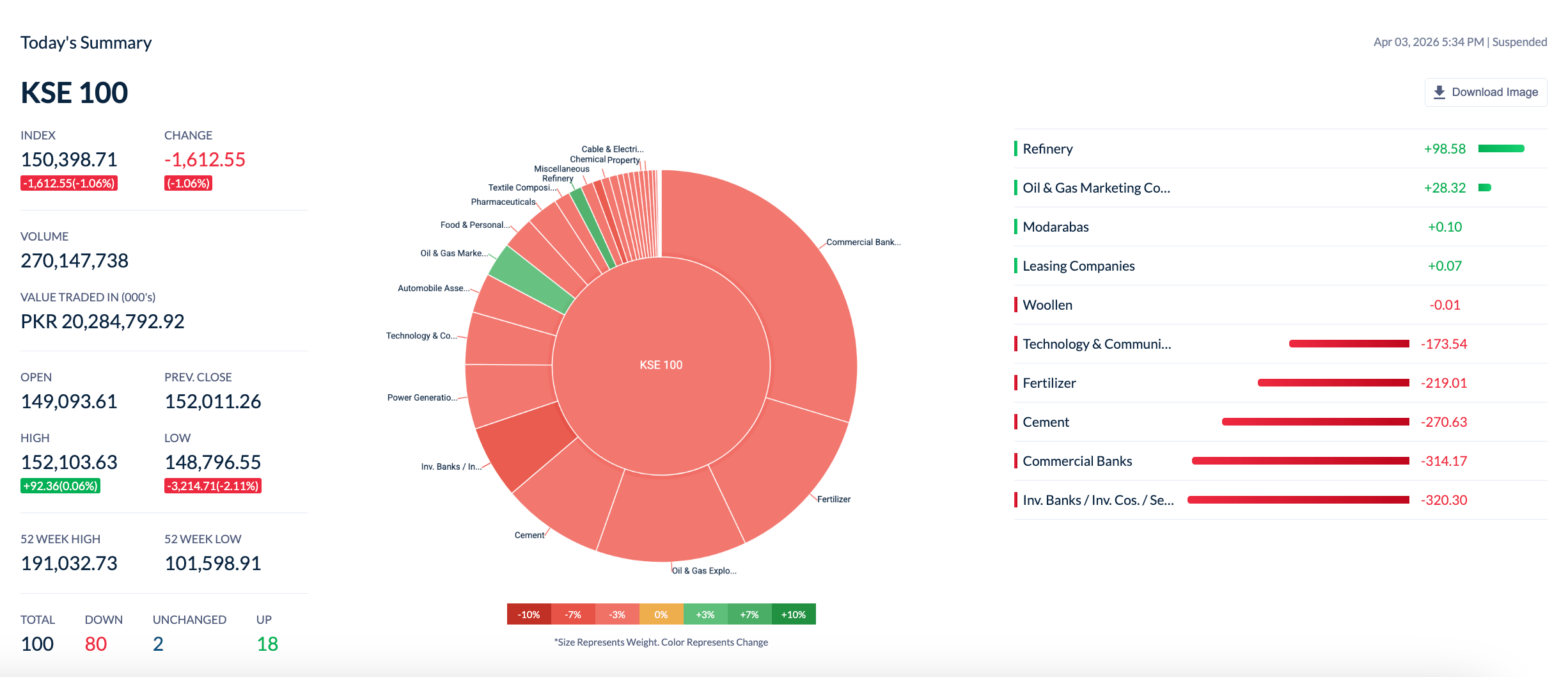
Pakistan’s stock market faced another challenging week, with investor sentiment weighed down by ongoing geopolitical tensions and rising global oil prices. The benchmark KSE-100 Index closed at 150,399, down 1,309 points or 0.9% week-on-week. Volatility remained a constant feature, as uncertainty from global and regional developments fueled persistent selling pressure throughout the week.
Govt raises Rs753bn on mixed T-bill yields
The government raised a total of Rs753 billion in treasury bills, with yields showing a mixed response to March’s 7.3 percent inflation. One-month T-bills saw yields fall to 11.18 percent, three-month papers rose to 11.50 percent, six-month yields slightly dropped to 11.49 percent, and 12-month bills increased to 11.50 percent. Financial experts say a rate cut at the State Bank of Pakistan’s April 27 Monetary Policy Committee meeting is unlikely, especially if the Gulf conflict continues to push inflation higher.
Pakistan to return $3.5bn UAE debt before month end: official
Pakistan has decided to return $3.5 billion in debt to the United Arab Emirates before the end of the month, prioritizing “national dignity” over the impact on foreign exchange reserves, a senior official said. The funds, originally provided by the UAE in 2019 to stabilize Pakistan’s balance of payments, had been rolled over multiple times, with recent extensions shortened to one month. The repayment ends uncertainty over these deposits but will sharply reduce the State Bank of Pakistan’s reserves by about 18 percent, putting pressure on the country’s external buffer even as Pakistan works to meet IMF programme requirements.
Shariah-compliant mutual funds in Pakistan have just crossed the Rs. 2 trillion mark for the first time, showing that more and more investors are looking for smart, Shariah-friendly ways to grow their money. Curious to see what all the buzz is about? Explore all Islamic and conventional mutual funds on Behtari here and start investing with ease.
Find your fit and invest confidently: behtari.com/mutual-funds
Get to Know More About Our Products
Behtari – Your all-in-one mutual funds investment App.
StockIntel – Your comprehensive PSX Trading and Analytics Platform.
Data Solutions – Unlock the power of data for smarter, more informed investing decisions.
Wealth Management – Smart wealth solutions for modern investors
Today’s Pulse by Capital Stake is brought to you by Hubab Irfan